Direct Car Insurance Quotes
Learn how direct car insurance quotes work, what information you need, and how to compare insurers properly
FREE Auto Insurance Comparison
 Secured with SHA-256 Encryption
More drivers are opting for “Direct car insurance quotes” to save more money on the coverage they need. When consumers buy direct coverage, it means getting a quote straight from an insurance company’s website or app, without going through an independent agent or broker. People also sometimes use the phrase when they’re specifically looking for Auto Insurance online. Either way, the goal is the same: get pricing fast, compare accurately, and lock in coverage that fits your budget.
This guide explains what “direct insurance quotes” really mean, what you need to quote, how to compare quotes the right way, what to watch out for, and how to get better prices without accidentally buying the wrong coverage.
ARTICLE GUIDE
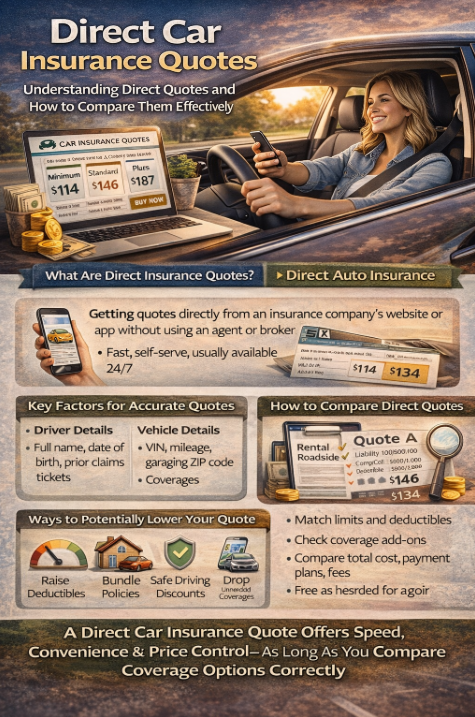
What “Direct Car Insurance Quotes” Really Means
A direct quote is generated by an insurer’s own quoting system, typically online. You enter your information, pick coverages, and get a price—often within minutes. Many major carriers are built for this workflow: you start a quote, adjust options, and buy without needing an agent appointment.
One advantage is speed and convenience. Direct buying can be done anytime and is often quicker, with less pressure to add extras you don’t want.
The tradeoff is that you’re responsible for choosing limits and coverage types correctly. Without guidance, some drivers may find it harder to determine what they truly need.
Direct Quotes vs. Agents
Direct quotes are not automatically cheaper. Sometimes they are, sometimes they aren’t. The price comes from underwriting factors such as driving history, garaging address, vehicle, and coverage choices—not from whether you clicked “buy” on a website or spoke to someone.
The real difference is the process.
Best for shoppers who want speed, flexibility, and a self-serve quoting experience.
- Fast, self-serve, and often available 24/7
- Easy to test different deductibles and coverage limits
- Minimal human guidance unless you call or chat
Better for drivers with more complex needs who want expert guidance.
- Helpful if your situation is complex (multiple drivers, SR-22, business use, rideshare, teen drivers, prior cancellations)
- Can match you with carriers you may not think to quote on your own
- Slower depending on availability and back-and-forth
Direct quotes are great when you know what you need and want speed. Agents can be valuable when you want advice or your scenario is messy.
What You Need Before You Start Getting Direct Quotes
Getting accurate direct car insurance quotes depends on entering consistent, correct information. Most insurer quote flows ask for a similar set of details.
Driver details
- Full name, date of birth, driver’s license (sometimes optional early in the quote)
- Marital status (often affects pricing)
- Years licensed
- Tickets, accidents, and claims history (often 3–5 years)
- Current insurance status and prior limits (continuous coverage can matter)
Vehicle details
- VIN (best) or year, make, model, trim
- Ownership (owned, financed, leased)
- Primary use (commute, pleasure, business)
- Approximate annual mileage
- Garaging ZIP or address
Coverage preferences
- Liability limits (bodily injury, property damage)
- Deductibles for comprehensive and collision (if selected)
- Optional coverages (rental reimbursement, roadside, uninsured motorist)
A useful shortcut is to pull up your current declarations page so you can mirror limits and deductibles when comparing.

How Direct Insurance Quote Engines Work
When you search for car insurance quotes direct and online, there is a lot of activity that takes place behind the scenes, including quote engines that:
- Estimate risk: Evaluate your driver, vehicle, and location profile and assign a rate based on underwriting rules and pricing models.
- They price the coverage you select: Your coverage choices matter as much as your driving profile. A “cheap quote” can simply mean low limits and high deductibles.
Many sites will show you a default package first. Don’t accept it blindly. Your best price-to-protection ratio comes from adjusting limits, deductibles, and optional coverages intentionally.
The Best Way to Compare Direct Car Insurance Quotes
If you compare quotes incorrectly, you’ll choose the wrong “cheapest” option.
Keep these the same across quotes:
- Liability limits (example: 100/300/100, or your state minimum if you truly want the bare minimum)
- Comprehensive deductible (example: $500)
- Collision deductible (example: $1,000)
- Uninsured or underinsured motorist selection (on/off and limits)
- Rental and roadside (on/off)
- Driver list and vehicle list
Only then does the price comparison mean anything. Also, compare these details that change the real cost:
- Payment plan fees and installment options
- Required down payment
- Policy term (6-month vs 12-month)
- How claims and support work (online, app, phone)
Top Best Direct Car Insurance Providers
When you’re shopping for direct car insurance quotes, the company you quote with matters just as much as the number you see. Some providers excel at low prices, others at digital convenience, and some are strong for specific driver profiles (teens, high-risk, long-distance commuters, etc.). The list below highlights five of the most reputable direct car insurance companies and what they’re known for.
GEICO — Affordable Quotes with Easy Online Shopping
GEICO is consistently ranked as one of the most popular choices for drivers seeking fast, direct car insurance quotes. It has built its reputation on a simple, streamlined online quoting process that allows customers to get pricing quickly and adjust coverages without confusion.
💡 What GEICO is known for:
- ☑️ A quick and intuitive online quote engine
- ☑️ Competitive pricing for clean-record drivers
- ☑️ Discounts for good drivers, federal employees, military personnel, and safety features
- ☑️ Strong mobile app for policy management and claims tracking
GEICO’s direct quote experience is ideal for drivers who want fast pricing and solid coverage without visiting an agent. It tends to be especially strong for liability and standard full coverage for drivers with clean records.
Progressive — Flexible Tools and Snapshot Telematics Discounts
Progressive stands out for its robust quoting and pricing tools, which let you tailor your coverage in real time. The direct quoting experience is enhanced by helpful features that make it easier to understand how different choices affect price.

📈 What Progressive is known for:
- ☑️ Intuitive online quote process with real-time price adjustments
- ☑️ Snapshot and other usage-based programs for safe drivers
- ☑️ Strong bundling options with homeowners and other lines
- ☑️ Broad market availability
Progressive’s emphasis on tools and transparency makes it a great option for drivers who like to experiment with different coverage options and see how they influence price.
USAA — Best for Military Families
USAA isn’t available to everyone, but for those who qualify (active duty, veterans, and their families), it consistently earns high marks for pricing, service, and member satisfaction. Its direct quote tools are straightforward, and its coverage options are broad and well priced.

🎯 What USAA is known for:
- ☑️ Exceptional customer service and claims satisfaction
- ☑️ Competitive pricing across many driver profiless
- ☑️ Rewards and discounts tailored to military life
- ☑️ Excellent mobile and digital experience
USAA is often cited as a top choice for military families because it blends digital convenience with relationship-oriented service and pricing that often beats the national average.
Metromile — Pay-Per-Mile Insurance That Rewards Low Mileage
What Metromile Is Known For
Metromile is one of the early pioneers in usage-based insurance that charges based on how much you drive. For drivers with low mileage, this model can result in substantial savings compared to traditional pricing. Metromile’s direct quote system lets you estimate pricing based on expected mileage and see how the per-mile pricing structure compares with standard premiums.

🎯 Why drivers consider Metromile:
- ☑️ Potential savings for low-mileage drivers
- ☑️ Easy digital quote and policy management
- ☑️ Mileage tracking through a device or app
- ☑️ Transparent price structure
Metromile is especially potent for urban drivers, remote workers, or anyone who drives significantly less than the average.
Hugo — Flexible, On-Demand Liability Coverage
What Hugo Is Known For
Hugo is a newer entrant that offers flexible liability coverage that can be activated for days, weeks, or as needed. This is particularly useful for drivers who don’t use a vehicle often and want to pay only for the actual coverage period. Hugo’s direct quote process is designed around this flexibility, helping drivers estimate costs based on usage rather than a full annual policy.
🎯 Key features that stand out:
- ☑️ Short-term and on-demand coverage options
- ☑️ Digital first quote and purchase experience
- ☑️ Lower costs for intermittent drivers
- ☑️ Liability focus keeps pricing competitive
Hugo is ideal for drivers who only need occasional insurance, such as on weekends, for summer use, or for drivers with multiple transportation modes.
The Biggest Factors That Drive Your Direct Quote Price
Even with identical coverages, prices can differ dramatically between insurers. Common pricing drivers include:
- Location and garaging address
- Driving record
- Insurance history (continuous coverage vs lapse)
- Vehicle type and repair costs
- Annual mileage and usage
- Credit-based insurance score (in many states)
- Your selected limits and deductibles
No single company wins for everyone because each insurer weighs these factors differently.
Picking Coverage That Doesn’t Sabotage Your “Cheap Quote”
If you only chase the lowest number, you can easily underinsure yourself.
Where to Get Direct Car Insurance Quotes
Most major insurers like Geico offer direct quote flows. Common “direct quote” targets include large national brands, regional carriers in your state, and non-standard insurers if you have tickets, a lapse, or a DUI.
You can also use comparison platforms, but if your goal is “direct quotes,” you typically get the cleanest apples-to-apples pricing by quoting directly with multiple insurers while keeping coverage settings identical.
How to Lower Your Direct Quote in Legitimate Ways
There are real ways to reduce premiums without playing games.
- Raise deductibles thoughtfully: If you have savings, increasing comprehensive and collision deductibles is one of the fastest levers.
- Drop collision and comprehensive on low-value, paid-off vehicles: If your car is worth only a few thousand dollars, full coverage may not be worth the premium.
- Test a few liability tiers: Sometimes moving from minimum limits to a moderate package changes the price less than expected. Try different limit levels and see what the cost difference is.
- Bundle when it truly saves: Home or renters bundling can reduce costs, but not always. Quote both ways.
- Use telematics or usage-based programs if you drive safely: If you consistently drive smoothly, these programs may help. If you drive aggressively, they can backfire.
- Ask about discounts that match your profile: Common examples include multi-car, safe driver, good student, anti-theft, paperless billing, and pay-in-full.
- Watch payment plan choices: Monthly installments can include fees. Sometimes paying in full or increasing the down payment reduces the total cost.
- Keep continuous coverage: Even one lapse can increase future quotes.
Direct Car Insurance Quotes for High-Risk Drivers
If you have a DUI, SR-22 requirement, recent at-fault accidents, multiple tickets, poor credit (where allowed), or prior cancellations, direct quotes can still work, but you’ll want to shop a wider set of insurers.
The most important strategy for high-risk drivers is avoiding coverage lapses and rebuilding their profile over time. Even one clean year can improve what’s available and reduce pricing at renewal.
Common Mistakes That Make Direct Quotes Inaccurate
- Entering the wrong trim or missing safety features (use the VIN when possible)
- Guessing mileage unrealistically
- Forgetting a household driver
- Comparing different coverages and thinking you found a deal
- Ignoring fees and down payments
- Choosing limits that don’t match your real risk
A Simple Direct-Quote Workflow that works every time
Frequently Asked Questions About Direct Car Insurance Quotes
What are direct car insurance quotes? +
Are direct car insurance quotes cheaper than using an agent? +
Can I buy a policy immediately after getting a direct quote? +
What information do I need to get an accurate direct quote? +
Why do quotes change when I adjust coverage options? +
Is it safe to get quotes directly online? +
How many direct quotes should I compare? +
Do direct quotes include all fees and costs? +
Can high-risk drivers get direct car insurance quotes? +
What’s the biggest mistake people make with direct car insurance quotes? +
The Final Word On Direct Car Insurance Quotes
Direct car insurance quotes are powerful because they’re fast and let you test coverage options instantly. But the “cheapest” quote is only meaningful if you compare identical coverages and account for deductibles, fees, and real-world protection.
If you want, tell me your state, whether your car is owned or financed, and whether you want minimum coverage or solid protection, and I’ll give you a clean coverage template you can use to compare direct quotes properly. Compare direct car insurance quotes where you live in under 5 minutes and save more money on the coverage you want.
Let the companies fight for you. Get a Quote!
Compare Quotes From Top Rated Insurers. Good Drivers Can Get Good Discounts. See How Much You Can Save Now!
Secured with SHA-256 Encryption
Our Company

CALL US 1-(888) 666-9107
TRUST & AUTHORITY


AUTO INSURANCE 101
SEARCH
Looking for something specific? Use the search bar below to find answers to your questions!